---
title: "Designing loops with Fable 5"
author: "Lance Martin (@RLanceMartin)"
source_url: "https://x.com/RLanceMartin/status/2064397389189071163"
published_at: "2026-06-09T17:21:06.000Z"
fetched_at: "2026-06-11T03:37:55Z"
updated_at: "2026-06-11T03:37:55Z"
language: "en"
review_status: "source-checked"
---
# Designing loops with Fable 5
Mythos-class models like Claude Fable 5 have changed the way many of us work at Anthropic. I want to share two tips for getting the most out of this class of models.
**Self-correction loops**
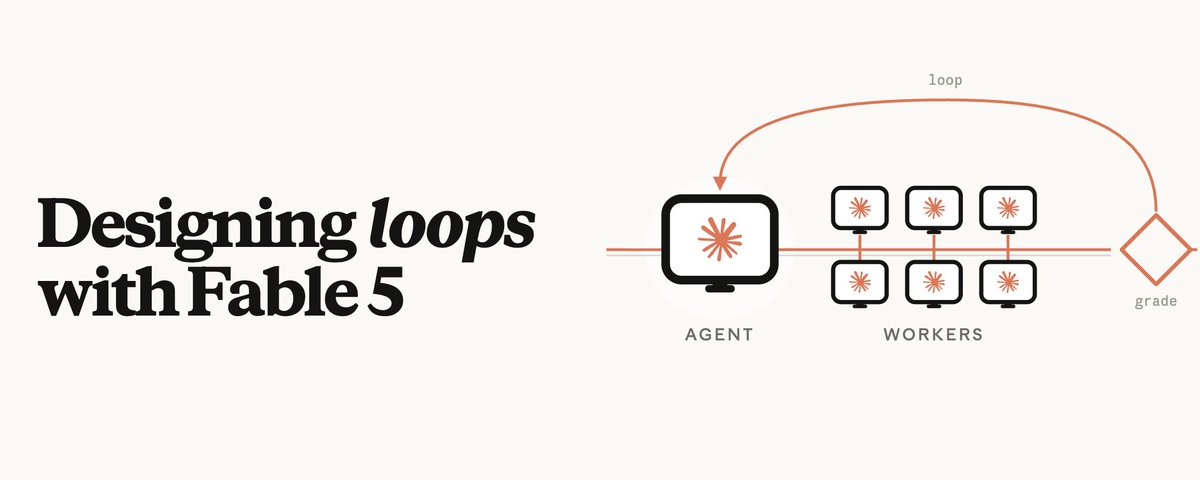
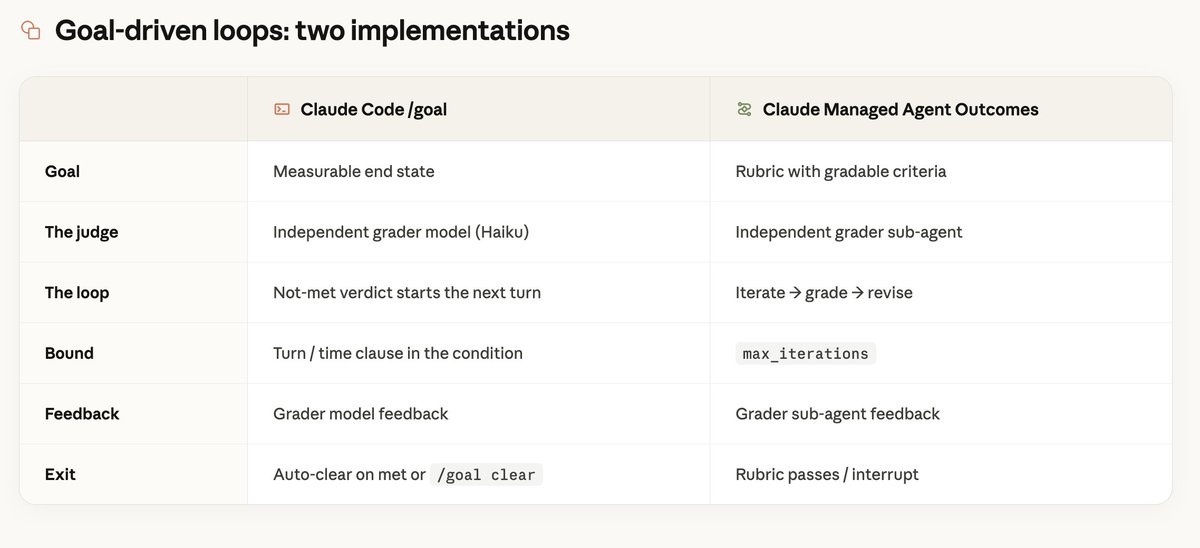
There’s been a lot of interest in loops recently. @bcherny [has mentioned](https://x.com/sairahul1/status/2064279904989147577?s=20) that “(his) job is to write loops.” Letting models hillclimb on an evaluation is a common recipe for improving task performance: [/goal](https://code.claude.com/docs/en/goal) in Claude Code and [Outcomes](https://platform.claude.com/docs/en/managed-agents/define-outcomes) in Claude Managed Agent are primitives that let you apply this general recipe for your specific task.
As mentioned in our [prompting guide](https://platform.claude.com/docs/en/build-with-claude/prompt-engineering/prompting-claude-fable-5), Fable 5 is good at self-correcting in a loop. A well designed goal or rubric adds feedback to the environment that Claude is running in. This let’s Claude run, collect feedback via the goal or rubric, self-correct, and proceed until the goal or rubric is satisfied.
I’ll share one toy example that I used to test Fable: [Parameter Golf](https://github.com/openai/parameter-golf) is an open source ML engineering challenge to train the best model that fits in a 16MB artifact in < 10 minutes on 8xH100s.
It’s a bit like @karpathy's [autoresearch](https://github.com/karpathy/autoresearch) project: it tests the ability of an agent to edit basic training code (a single train_gpt.py file), launch training, poll the log, read the score, and decide what experiment to run next.
I compared Fable 5 to Opus 4.7 on this challenge using [Claude Managed Agents](https://platform.claude.com/docs/en/managed-agents/overview) (CMA). CMA provides [the agent harness as well as a hosted sandbox](https://www.anthropic.com/engineering/managed-agents), so it’s well-suited for long-running tasks with Fable 5. For Parameter Golf, I gave CMA access to 8xH100 GPUs as a [self-hosted sandbox](https://platform.claude.com/docs/en/managed-agents/self-hosted-sandboxes).
One subtle point: *what* does the judging is important. We’ve seen that models have problems with self-critique on their *own* outputs. Prithvi Rajasekaran wrote about this in our engineering blog [here](https://www.anthropic.com/engineering/harness-design-long-running-apps).

We’ve found that a verifier sub-agent [tends to outperform](https://platform.claude.com/docs/en/build-with-claude/prompt-engineering/prompting-claude-fable-5) self-critique with Fable 5, because grading is done in an independent context window. [Outcomes](https://platform.claude.com/docs/en/managed-agents/define-outcomes) in CMA handles this by spawning a grader sub-agent for you.
For each test, I supplied a rubric (a file) with the nine checkable criteria (e.g., run a baseline, run 20 experiments, etc). Then, I ran Parameter Golf for up to 8 hours. The Outcomes grader confirmed that all experimental criteria were met before allowing Claude to stop the work.
Fable 5 improved the training pipeline ~6x more than Opus 4.7. If we consider experiments as structural (e.g., architecture changes) or scalar (e.g., adjusts a constant), Fable 5 bet on larger structural changes and showed resilience (e.g., pushing through a quantization regression to its biggest win).
Opus 4.7's first experiment produced a small win and nearly everything after followed the same template: adjust a scalar, measure, keep if positive.
**Memory**
Memory is [another area where Fable excels](https://platform.claude.com/docs/en/build-with-claude/prompt-engineering/claude-prompting-best-practices). We can think about this as a outer loop that spans across sessions: Claude writes to memory during a session and those memories can be retrieved in future sessions.
@pgasawa and team recently published Continual Learning Bench 1.0, so I wanted to test this on Fable 5 vs earlier models.
https://x.com/i/status/2051361012838957144
I compared Fable 5, Opus 4.7, and Sonnet 4.6 on one of the tasks from the benchmark: the task asks an agent to answer sequential questions given access to a SQL database. Each question is a separate agent session and memory is provided.
For this, I used CMA with [memory](https://platform.claude.com/docs/en/managed-agents/memory), which gives each agent access to a mounted filesystem that can be shared across sessions.

For this task, effective use of memory benefits from a progression: fail (get something wrong and document), investigate (before moving on, figure out why), verify (turn the diagnosis into a checked fact), distill (turn verification into a general rule), and consult (read the rule, instead of re-deriving it).
Sonnet 4.6 exits around step 1: its store is a list of failure notes and open guesses (e.g., "*maybe prc instead of prc_usd?*"). It rarely consults prior notes. To improve performance, task-specific memory instructions are needed.
Opus 4.7 exits around step 3: it creates a schema reference with uncertainty flagged (e.g., *"possibly prc in cents? Verify."*), but verification coverage is low: at 7-33% of questions (median run ~17%).
Fable 5 tends to complete the progression: in its strongest runs, verification coverage is up to 73% (22 of 30) and it distills learnings into general rules that help with future tasks.
---
Rather than directly prompting and steering Fable 5, it's often better to design loops that let the model to self-correct in response to environment feedback (e.g., /goal or Outcomes) and manage its own context (e.g., via memory).
I've shared just a few small scale experiments that I've run, but its worth testing Fable 5 for yourself on challenging tasks and using loops for self-correction or memory.
To get started, see our [docs](https://platform.claude.com/docs/en/build-with-claude/prompt-engineering/prompting-claude-fable-5) or ask the latest version of Claude Code, which can use our built-in [/claude-api](https://github.com/anthropics/skills/tree/main/skills/claude-api) skill to tell you about Fable 5 (e.g., prompting best practices), /goal, Claude Managed Agents, or other API features.