
I've put deep thought into constructing this piece, and it's literally what I would tell the 20 y/o version of myself to read.
This article is about the three paths to winning the AI gold rush - and how to figure out which one is yours.
Before we dive in, I want to set a clear definition of what I believe "winning" the AI gold rush looks like.
If you align with my definition, and you want the outcomes mentioned, I encourage you to stick around and read the full article.
In this context, winning means your life is measurably improved because of AI.
That can be: more income, more time, more optionality, better job security, more skills.
In short, AI is helping you build the life you want, and you're in a position that gets stronger as AI improves rather than more vulnerable.
Most people right now are trapped by AI without even knowing it. Their job is quietly becoming easier to automate, their skills are becoming less valuable, and their market value is decreasing as a result.
To avoid being trapped by AI, I've come up with three distinct "architects."
Aka three paths that I think the average person can utilize to win the AI gold rush, and use AI to help shape the life they want.
I'll guide you through each path and exactly how to pick yours. There is value here for everyone. It doesn't matter if you're an experienced corporate finance analyst or a young, aspiring entrepreneur.
Architect One: Career Architect
Architect Two: Income Architect
Architect Three: Venture Architect
Architect One: Career Architect
This is the path most people overlook because it doesn't sound as exciting as building an AI startup or going viral on X. But, risk-adjusted, it is the highest-percentage play available to most people right now.
The Career Architect uses AI to become the most valuable and irreplaceable person inside their current company or industry.
They do NOT quit their job, and they do NOT build a side hustle. In fact, they put all their energy into their careers and winning from the inside, using AI to produce better/more efficient outputs.
Who is this path for?
The Career Architect path works best for people who like their industry/career direction and don't want to pivot because of AI.
I'm talking to white-collar workers and anyone who is currently exposed to AI automation (blue-collar/physical work - medicine, nursing, etc., seems "safe" for the foreseeable future, so I'm not going to address those workers here).
What to do
Three things separate Career Architects from everyone else in their company:
First, domain-specific AI workflows. The Career Architect builds workflows tailored to the exact problems/SOPs their company faces.
A real example from my AI company: The marketers who have used AI to automate their content research and content production processes to produce better-performing content are the ones I'm actively keeping and promoting, while I look to replace those who still do everything manually.
Secondly, to build domain-specific workflows, you need a sense of AI curiosity + a willingness to learn.
Think: taking AI courses, attending seminars, collaborating with other AI-native people in your company, etc.
Lastly, you need to have a bare-bones technical understanding of AI.
I do not mean becoming a full-stack developer.
I mean, learning how to set up basic n8n workflows, Claude Skills, OpenClaw agents, etc.
If you are a software engineer (or in a technical role), you should learn AI dev tools like Claude Code and Codex.
TLDR: You need to become the "AI guy" in your company that genuinely provides value.
To be clear, this is not a guarantee that your company will not automate your role. Some roles will disappear regardless of what you build. But the Career Architect gives themselves two things nobody else in their company has: a reason to be kept, and the skills to land somewhere better if they are not.
We are heading into a world where teams of 10 are being cut to 3, and those smaller teams will orchestrate AI to produce the same results. The entire point here is to increase your odds of being in the group of 3.

Below is an excellent article to follow up with if you think the Career Architect pathway is for you.
It teaches you how to take this architect to the next level and become truly irreplaceable in the AI era:
Embedded X Article: How to be Irreplaceable in the AI Era
Architect Two: Income Architect
If the Career Architect wins from the inside, the Income Architect wins on the outside.
This is the solo founder who uses AI to create income streams that exist independently of their employer.
Who is this path for?
The Income Architect is the path for anyone who wants financial independence without the full risk of Path 3. It has a higher ceiling than the Career Architect and a lower risk profile than the Venture Architect. Think of it as the middle ground option out of the three.
The Income Architect path works best for people who want to generate income outside their 9-5. I'm talking to college students, young entrepreneurs, and really anyone who has the drive to build a "side hustle" with AI.
Low barrier to entry with high upside if you play your cards right. However, you do need a skill the market is willing to pay for and then leverage AI to ship at scale.
What to build
I'm going to spitball two models to you:
1. Productized AI Services:
Take a repeatable skill (content creation, research, outreach, design) and build an AI workflow around it. Then, sell the output.
My advice here:
pick a niche, learn the pain points, then learn how to fix that problem with AI as the cherry on top.
You can also target local SMBs (your competition will likely be low).
2. Content and Audience Monetization:
Build a personal brand around AI expertise in a specific niche. The audience becomes the asset. Courses, newsletters, consulting inquiries, and partnership opportunities all flow from building distribution.
If you're paying attention, you'll see that this is where most people on X are focusing. Building distribution also gives you access to tons of opportunities and a powerful network.
You only really need 1,000-10,000 followers on X to receive high-paying AI opportunities (consulting, side jobs, etc.).
Trust me, I've seen it with people in my network.

Of course, there are more than two business models to consider here. These are just the two most notable I wanted to highlight.
Below, I break down 7 high-paying AI skills - perfect read if you plan on taking this path:
Embedded X Post: x.com/aiedge_/status/2031735799994265818
Architect Three: Venture Architect
This is the hardest path. It is also the one with the highest ceiling.
The Venture Architect builds something from scratch - an AI-native product, tool, agency, or company. They are not using AI to improve their job or sell a service. They are using AI to build an asset that can scale beyond a solo-founder model.
This path is not for everyone. It requires experience, tolerance for risk, and the ability to operate with uncertainty for extended periods before seeing meaningful returns.
But for the right person, at the right stage, it is the most powerful wealth-creation opportunity of this generation (I've personally decided to pursue this path).
Who is this path for?
The Venture Architect path works best for people with prior successful entrepreneurial experience and resources (money to invest, a network, a team, etc.).
The best Venture Architects are not first-time experimenters. They are experienced, and really, they're former Income Architects who have built skills, credibility, and market understanding - and are now ready to package that into something that can scale.
One honest note: the Venture Architects I respect most did not start here. They started on Path 1 or Path 2, built something real, and eventually had no choice but to go bigger.
What to build
If this is really the correct path for you, you'll know exactly what to build.
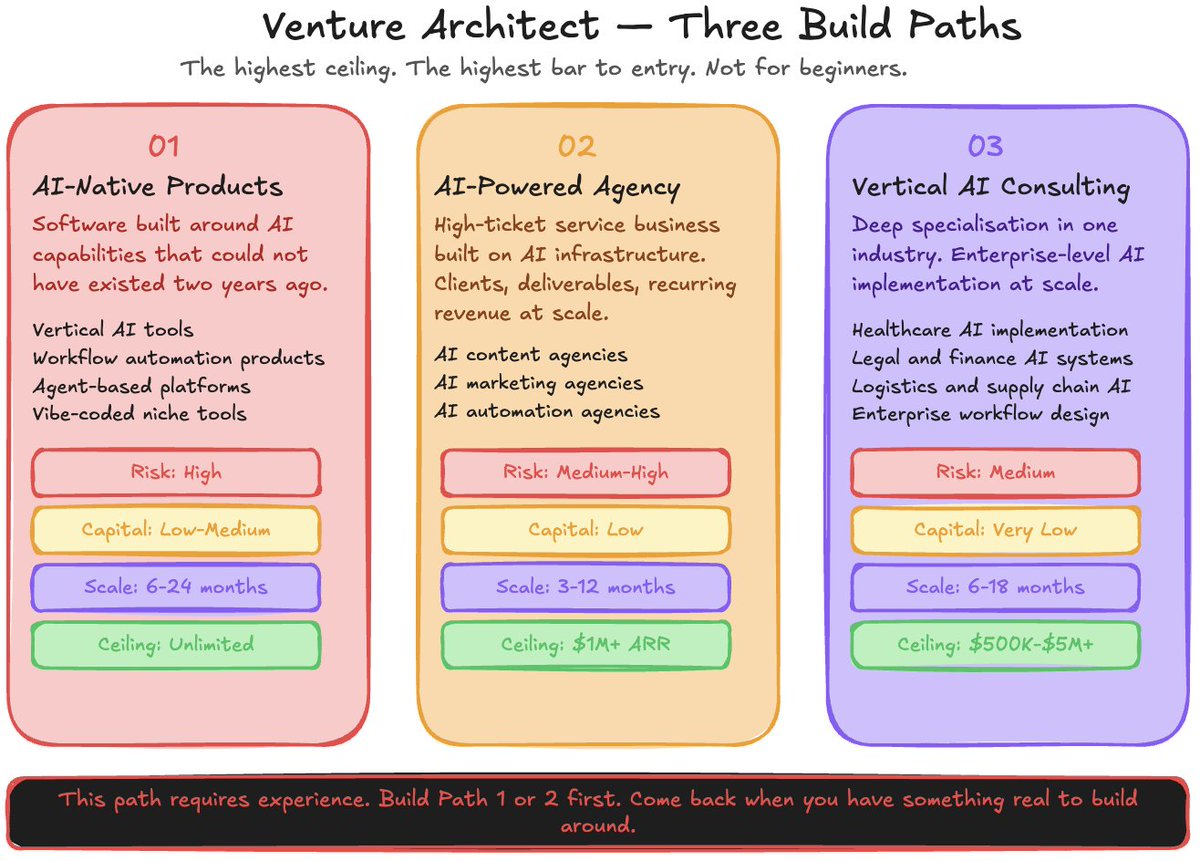
The best Venture Architects I know are focusing on three specific domains:
1. AI-native tools and products:
Software built specifically with AI capabilities that could not have existed two years ago.
For example, I have friends in the trading space who are building AI-powered trading journals. They know the pain points, they know what to build, and they have the means to execute and distribute.
2. AI-powered agencies:
High-ticket service businesses built on AI infrastructure. An AI agency built properly can serve dozens of clients at margins a traditional agency could never achieve.
3. Vertical AI consulting and implementation:
Deep specialization in a single industry (healthcare, legal, finance, logistics) combined with the ability to design and implement AI systems at an enterprise level.
Tip:
At this level, a combination of all paths can work well.
For example, my AI company (where you're reading this right now) is focused on AI distribution/media and building AI products at scale. The two paths serve each other well, and most people in my company are also AI-native (career architects). It's a combination of all paths to push the ceiling as high as possible.
Final Thoughts
I want to leave you with this:
The mistake most people make is waiting until they have more information, a better plan, or more certainty before committing (not just in AI, but most things). In my experience, that waiting period is a trap.
The people winning the AI gold rush (or life in general) are simply the ones who tried something, failed, and did their best to iterate until it worked.
If you read this entire article, I think you'll know exactly which architect you fall into. I'd encourage you to start down the path that speaks to you most, and, if needed, pivot.
In the AI era, the biggest risk is not taking any at all, and I can't emphasize how important speed/agency is becoming.
I'm publishing AI content like this 3x/week (Monday, Wednesday, and Friday). If you want to see more practical AI frameworks like this on your feed, be sure to follow me @aiedge_. I have lots of exciting content in the works!
Lastly, if you can, please Like/Repost this article so others can find it 💙