

人人都在谈论大语言模型。
却没人讲清楚它们在底层到底是怎么运转的。
GPT、Claude、Gemini、Llama。
它们全都出自同一条 5 阶段流水线。
而一旦你理解了它,你就能自己造一个出来。
不是 GPT-4 的克隆版。
而是一个真正能跑的语言模型。
一个能从文本中学习、生成新文本、而且言之有物的模型。
我造了一个。下面就是它确切的运作方式。
不需要博士学位。代码也附上了。
人人都信以为真的那个关于大语言模型的谎言
大多数人以为,构建一个大语言模型,关键在于架构。
Transformer。注意力头。层数。
并非如此。
Transformer 架构是公开发表的。每一家主流实验室用的,大体上都是同一套基础组件。
如果架构就是那个秘密,那人人都该有 GPT-4 了。
真正的秘密是:数据、训练和对齐。
架构只是一段话。其余的一切,才是真正决定一个模型成败的地方。
下面就是这 5 个阶段。
第 1 阶段 — 数据 (模型真正的胜负手)

互联网原始文本脏得很。
你没法直接拿它来训练。
Common Crawl —— 用来训练大多数大语言模型的那份公开网页抓取数据 —— 包含 2500 亿个页面、超过一百万 GB。
但其中大部分是垃圾。
重复的页头。垃圾广告。有毒内容。个人数据。只有 3 个词的低质量页面。
在任何训练开始之前,你得跑一套严酷的多步过滤:
→ 从原始 HTML 中抽取干净文本
→ 过滤掉有害、不适宜(NSFW)和个人数据
→ 按 URL、文档、行做去重
→ 按词数和 token 密度剔除低质量文档
→ 跑一遍基于模型的质量打分 —— 维基百科的编辑会愿意引用这个页面吗?
→ 在代码、书籍、科学和网页之间平衡数据配比
结果是:一份干净的数据集,体量只剩原始的一小部分,但质量好得多。
要刻进脑子里的那条规矩:
数据质量胜过数据数量。每一次都是如此。
这个领域里守得最严的秘密,不是架构。
而是数据是怎么被清洗的。
第 2 阶段 — 分词 (把文本拆成模型真正能学习的碎片)
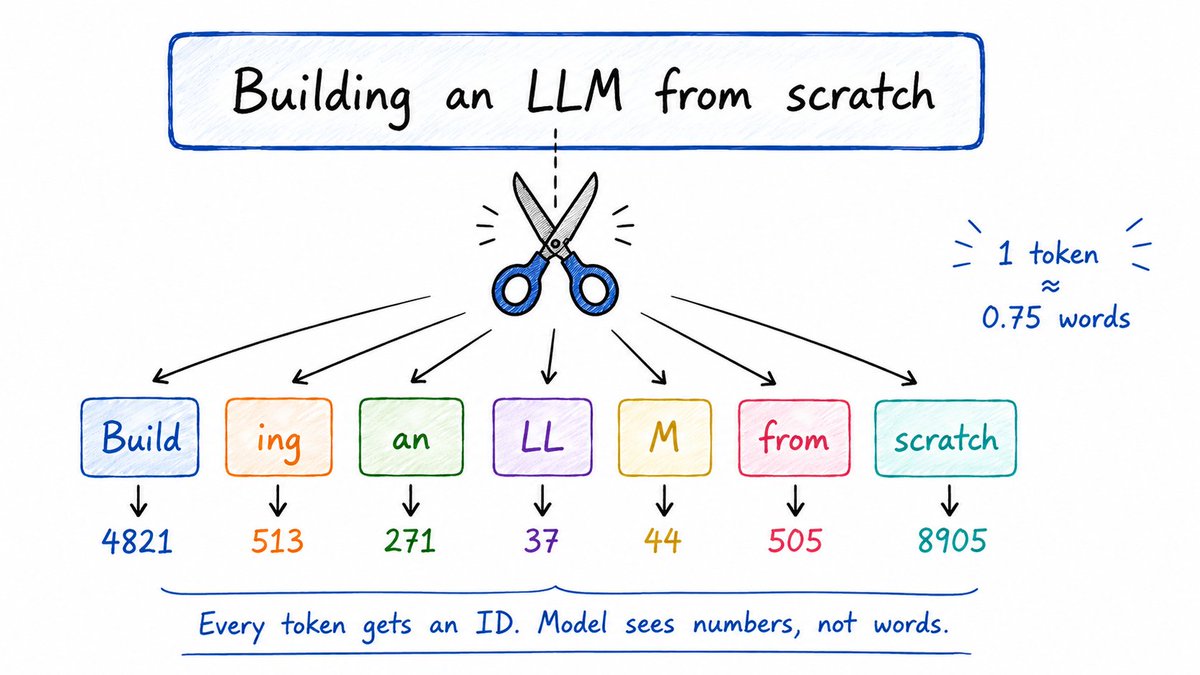
模型从不读取原始文本。
它读取的是 token。
一个 token 不一定是一个完整的词。它是一个词的一部分 —— 一个模型学会了把它当作一个单元来对待的片段。
“playing” → [“play”, “ing”] “unbelievable” → [“un”, “believ”, “able”] “dog” → [“dog”]
标准方法叫做 字节对编码(Byte-Pair Encoding,BPE)。
它从单个字符出发,反复合并最常见的字符对,直到得到一个固定大小的词表 —— 通常是 32,000 到 100,000 个 token。
下面是一个用 Python 写的极简分词器:
from tokenizers import Tokenizer, models, trainers, pre_tokenizers

# Initialize BPE tokenizer
tokenizer = Tokenizer(models.BPE())
tokenizer.pre_tokenizer = pre_tokenizers.Whitespace()

# Train on your corpus
trainer = trainers.BpeTrainer(
    vocab_size=32000,
    special_tokens=["<PAD>", "<BOS>", "<EOS>", "<UNK>"]
)
tokenizer.train(files=["your_data.txt"], trainer=trainer)
tokenizer.save("tokenizer.json")

# Test it
output = tokenizer.encode("Building an LLM from scratch is powerful")
print(output.tokens)
# ['Building', 'an', 'LL', 'M', 'from', 'scratch', 'is', 'powerful']

print(output.ids)
# [4821, 271, 3728, 44, 505, 8905, 318, 6787]
经验法则:1 个 token ≈ 0.75 个词。
1,000 个 token ≈ 750 个词。
一个 10 万的上下文窗口 = 差不多一整本小说。
第 3 阶段 — 训练 (一个简单得让人起疑的目标)

整个训练任务,听起来简单得不像会有什么威力:
预测下一个 token。
就这样。
给定 “The cat sat on the”,预测 “mat”。
把这件事在数以万亿计的样本上做一遍,奇妙的事情就发生了。
模型学会了语法。然后是事实。然后是推理。然后是怎么写代码、翻译语言、解数学题。
这些没有任何人教过它。
它们是从大规模的下一个 token 预测中涌现出来的。
下面是一个用 PyTorch 写的极简纯解码器(decoder-only)Transformer —— 每一个主流大语言模型背后都是同一套架构:
import torch
import torch.nn as nn
import math

class CausalSelfAttention(nn.Module):
    def __init__(self, embed_dim, num_heads):
        super().__init__()
        self.num_heads = num_heads
        self.head_dim = embed_dim // num_heads
        self.qkv = nn.Linear(embed_dim, 3 * embed_dim, bias=False)
        self.proj = nn.Linear(embed_dim, embed_dim, bias=False)

    def forward(self, x):
        B, T, C = x.shape
        q, k, v = self.qkv(x).chunk(3, dim=-1)

        # Split into heads
        q = q.view(B, T, self.num_heads, self.head_dim).transpose(1, 2)
        k = k.view(B, T, self.num_heads, self.head_dim).transpose(1, 2)
        v = v.view(B, T, self.num_heads, self.head_dim).transpose(1, 2)

        # Scaled dot-product attention with causal mask
        scale = math.sqrt(self.head_dim)
        attn = (q @ k.transpose(-2, -1)) / scale

        # Causal mask: can only attend to past tokens
        mask = torch.tril(torch.ones(T, T, device=x.device))
        attn = attn.masked_fill(mask == 0, float('-inf'))
        attn = torch.softmax(attn, dim=-1)

        out = (attn @ v).transpose(1, 2).contiguous().view(B, T, C)
        return self.proj(out)


class TransformerBlock(nn.Module):
    def __init__(self, embed_dim, num_heads, ff_dim, dropout=0.1):
        super().__init__()
        self.attn = CausalSelfAttention(embed_dim, num_heads)
        self.ff = nn.Sequential(
            nn.Linear(embed_dim, ff_dim),
            nn.GELU(),
            nn.Linear(ff_dim, embed_dim),
            nn.Dropout(dropout)
        )
        self.ln1 = nn.LayerNorm(embed_dim)
        self.ln2 = nn.LayerNorm(embed_dim)

    def forward(self, x):
        x = x + self.attn(self.ln1(x))   # attention + residual
        x = x + self.ff(self.ln2(x))     # feedforward + residual
        return x


class MiniLLM(nn.Module):
    def __init__(self, vocab_size, embed_dim, num_heads,
                 ff_dim, num_layers, max_seq_len, dropout=0.1):
        super().__init__()
        self.token_emb = nn.Embedding(vocab_size, embed_dim)
        self.pos_emb = nn.Embedding(max_seq_len, embed_dim)
        self.blocks = nn.ModuleList([
            TransformerBlock(embed_dim, num_heads, ff_dim, dropout)
            for _ in range(num_layers)
        ])
        self.ln_final = nn.LayerNorm(embed_dim)
        self.output = nn.Linear(embed_dim, vocab_size, bias=False)
        self.dropout = nn.Dropout(dropout)

    def forward(self, token_ids):
        B, T = token_ids.shape
        positions = torch.arange(T, device=token_ids.device).unsqueeze(0)

        x = self.dropout(
            self.token_emb(token_ids) + self.pos_emb(positions)
        )
        for block in self.blocks:
            x = block(x)

        x = self.ln_final(x)
        return self.output(x)  # logits over vocabulary


# Initialize a small but real model
model = MiniLLM(
    vocab_size=32000,
    embed_dim=512,
    num_heads=8,
    ff_dim=2048,
    num_layers=6,
    max_seq_len=1024
)

total_params = sum(p.numel() for p in model.parameters())
print(f"Parameters: {total_params:,}")
# Parameters: 44,082,176 — a 44M parameter model
接着是训练循环:
import torch.optim as optim
from torch.nn.utils import clip_grad_norm_

device = torch.device("cuda" if torch.cuda.is_available() else "cpu")
model = model.to(device)

optimizer = optim.AdamW(model.parameters(), lr=3e-4, weight_decay=0.01)
criterion = nn.CrossEntropyLoss()

def train_epoch(model, dataloader):
    model.train()
    total_loss = 0

    for input_ids, target_ids in dataloader:
        input_ids = input_ids.to(device)
        target_ids = target_ids.to(device)

        # Forward pass
        logits = model(input_ids)

        # Flatten for loss calculation
        loss = criterion(
            logits.view(-1, logits.size(-1)),   # (batch * seq_len, vocab)
            target_ids.view(-1)                  # (batch * seq_len)
        )

        # Backward pass
        optimizer.zero_grad()
        loss.backward()
        clip_grad_norm_(model.parameters(), max_norm=1.0)  # prevent explosions
        optimizer.step()

        total_loss += loss.item()

    return total_loss / len(dataloader)
模型实际上在学的是:
→ 每一个输入 token 都关注它前面的所有 token
→ 因果掩码(causal mask)让它无法窥探未来
→ 损失 = 模型对真实的下一个 token 有多“意外”
→ 损失越低 = 预测越准 = 模型正在学会语言
第 4 阶段 — 对齐 (把一个文本预测器变成一个助手)

预训练之后,你手里会有个挺唬人、但拿来聊天却没什么用的东西。
你问它一个问题,它没准回你三个新问题。
因为预测下一个 token,并不意味着它理解你想要什么。
两个步骤能解决这个问题。
步骤 1:监督微调(Supervised Fine-Tuning,SFT)
给模型看成千上万个例子:
提示词 → 理想回答
模型学会去模仿一个好答案的格式。
令人意外的一点是:你需要的数据非常少。
几千个例子就够了,因为知识早已存在于预训练好的模型内部。
SFT 只是教它用正确的格式把那些知识表达出来。
# SFT training example structure
sft_examples = [
    {
        "prompt": "Explain what an API is in simple terms.",
        "response": "An API is like a waiter in a restaurant. You (the app) tell the waiter (API) what you want. The waiter goes to the kitchen (server), gets it, and brings it back. You never go to the kitchen directly."
    },
    {
        "prompt": "What is the capital of France?",
        "response": "The capital of France is Paris."
    }
    # A few thousand of these is enough
]

# Format as: <prompt> [SEP] <response> <EOS>
# Fine-tune the pretrained model on these pairs
# Same training loop as pretraining — just different data
步骤 2:RLHF(基于人类反馈的强化学习,Reinforcement Learning from Human Feedback)
SFT 教的是格式。RLHF 教的是偏好。
模型生成两个答案。一个人挑出更好的那个。这些偏好用来训练一个奖励模型。然后对大语言模型做优化,让它最大化这个奖励。
这就是为什么 ChatGPT 和 Claude 用起来像个助手 —— 而不是随机的文本生成器。
没有 RLHF:
→ 流畅。能干。但不可靠。
→ 错得理直气壮。
→ 不知道什么时候该说“我不知道”。
有了 RLHF:
→ 有用。清楚。安全。
→ 学会了“一个好答案”究竟意味着什么。
第 5 阶段 — 评估 (证明它真的管用)

造一个模型却不去衡量它,那就是在瞎猜。
在预训练期间 —— 衡量困惑度(perplexity)。
困惑度衡量的是模型对真实文本有多“意外”。
困惑度越低 = 模型对文本预测得越好 = 它正在学习。
在 2017 到 2023 年之间,最好的模型把困惑度从“在约 70 个可能的 token 里犯难”降到了“不到 10 个”。
import torch
import math

def calculate_perplexity(model, dataloader, device):
    model.eval()
    total_loss = 0
    total_tokens = 0
    criterion = nn.CrossEntropyLoss(reduction='sum')

    with torch.no_grad():
        for input_ids, target_ids in dataloader:
            input_ids = input_ids.to(device)
            target_ids = target_ids.to(device)

            logits = model(input_ids)

            loss = criterion(
                logits.view(-1, logits.size(-1)),
                target_ids.view(-1)
            )
            total_loss += loss.item()
            total_tokens += target_ids.numel()

    avg_loss = total_loss / total_tokens
    perplexity = math.exp(avg_loss)
    return perplexity

# Example output progression:
# Epoch 1: Perplexity = 847.3  (model knows almost nothing)
# Epoch 5: Perplexity = 124.6  (getting better)
# Epoch 20: Perplexity = 23.4  (actually learning language)
对齐之后 —— 困惑度就不灵了。
微调过的模型在困惑度上得分更差,却有用得多。
你需要的是人类基准测试:
→ MMLU:57 个学科科目、多项选择 —— 衡量知识
→ Chatbot Arena:人类盲测对比两个模型并投票 —— 衡量偏好
→ AlpacaEval:用大语言模型来评判大语言模型 —— 与人类评委有 98% 的相关性,成本 10 美元
老实说:没有任何单一分数能完整刻画一个好模型。
同一个模型在同一个基准上,仅仅因为提示词的格式不同,就会得到 0.637 或 0.488 的分数。
评估是真的很难。
而且至今没有人把它彻底解决。
如何让你的模型生成文本

模型训练好了。
现在让它生成点东西。
def generate(model, tokenizer, prompt, max_new_tokens=100,
             temperature=0.8, device='cuda'):
    model.eval()

    # Encode prompt to token IDs
    token_ids = tokenizer.encode(prompt).ids
    input_tensor = torch.tensor(token_ids, dtype=torch.long,
                                device=device).unsqueeze(0)

    with torch.no_grad():
        for _ in range(max_new_tokens):

            # Keep only last max_seq_len tokens (context window)
            context = input_tensor[:, -1024:]

            # Forward pass
            logits = model(context)

            # Get logits for last token only
            next_token_logits = logits[:, -1, :]

            # Apply temperature (higher = more creative)
            next_token_logits = next_token_logits / temperature

            # Sample from probability distribution
            probs = torch.softmax(next_token_logits, dim=-1)
            next_token = torch.multinomial(probs, num_samples=1)

            # Append and continue
            input_tensor = torch.cat([input_tensor, next_token], dim=1)

            # Stop at end of sequence token
            if next_token.item() == tokenizer.token_to_id("<EOS>"):
                break

    # Decode back to text
    generated_ids = input_tensor[0].tolist()
    return tokenizer.decode(generated_ids)


# Test it
output = generate(
    model, tokenizer,
    prompt="The most important thing about machine learning is",
    max_new_tokens=100,
    temperature=0.8
)
print(output)
温度(temperature)控制创造力:
→ temperature = 0.1 → 安全、可预测、重复
→ temperature = 0.8 → 自然、有变化、不错的默认值
→ temperature = 1.5 → 有创意、出人意料、有时语无伦次
完整的流水线长什么样

之前:互联网原始文本,100 万 GB,完全没法用。
第 1 阶段之后:干净、过滤好的数据集,可以拿来训练了。
之前:原始文本,对模型而言毫无意义。
第 2 阶段之后:带 ID 的 token,模型的母语。
之前:随机的权重,输出的是垃圾。
第 3 阶段之后:一个理解语言模式的模型。
之前:一个用更多问题来回答问题的文本预测器。
第 4 阶段之后:一个会遵循指令、而且安全的助手。
之前:完全不知道这模型到底好不好。
第 5 阶段之后:基准测试、困惑度分数、人类评估。
每一个阶段都建立在上一个之上。
跳过任何一个,整套东西就崩了。
拖垮大语言模型项目的 5 个错误
1. 过度纠结架构。
Transformer 是标准化的。公开发表的。被到处抄的。
架构是最不重要的部分。
2. 把数据当成大路货。
脏数据会给你的上限封顶,不管你有多少算力。
顶级实验室花在数据清洗上的钱,比花在模型设计上的还多。
3. 跳过规模测算的数学。
一个相对其数据而言太大的模型,会训练不足、白白浪费算力。
最优比例:每个参数大约配 20 个 token 的训练数据。
4. 止步于 SFT。
一个微调过的模型只会模仿。没有 RLHF,它永远学不会人们真正偏好的是什么。
5. 对齐之后还相信困惑度。
后训练(post-training)会改变数据分布。
从你跑 SFT 的那一刻起,困惑度就不再有意义了。
立刻切换到人类基准测试。
那个让人不太舒服的真相
一个出色的大语言模型不是“训练”出来的。
它是“工程”出来的。
5 个阶段。不是 1 个。
架构只是第 3 阶段里的一段话。
真正要紧的一切,都在另外四个阶段里。
数据质量。规模测算的数学。对齐。诚实的评估。
这才是把 GPT-4 和一个业余玩票模型区分开来的东西。
两个架构完全相同的实验室,会做出天差地别的模型。
架构是共享的。
而真正要紧的一切,都不是。
从这里开始
想自己跑一下吗?下面是极简的搭建步骤:
# Full minimal LLM training setup
# Requirements: pip install torch tokenizers datasets

# 1. Get data
from datasets import load_dataset
dataset = load_dataset("wikitext", "wikitext-103-v1", split="train")
text = "\n\n".join([t.strip() for t in dataset['text'] if t.strip()])

# 2. Train tokenizer
from tokenizers import Tokenizer, models, trainers, pre_tokenizers
tokenizer = Tokenizer(models.BPE())
tokenizer.pre_tokenizer = pre_tokenizers.Whitespace()
trainer = trainers.BpeTrainer(vocab_size=8000,
                               special_tokens=["<PAD>","<BOS>","<EOS>"])
with open("corpus.txt", "w") as f:
    f.write(text[:5_000_000])  # use 5MB to start
tokenizer.train(["corpus.txt"], trainer)

# 3. Build model (use MiniLLM class from Stage 3 above)
model = MiniLLM(
    vocab_size=8000,
    embed_dim=256,       # small but real
    num_heads=8,
    ff_dim=1024,
    num_layers=4,
    max_seq_len=256
)
# ~15M parameters — trains on a laptop GPU in hours

# 4. Train (use train_epoch from Stage 3 above)
# 5. Generate (use generate() from Stage 5 above)

print("Your LLM is running.")
从小处起步。1500 万参数。WikiText 数据集。Google Colab 上的免费 GPU。
看着困惑度在几个小时里从 800 掉到 50。
那个下降的过程,就是模型在学习语言。
实时发生。
那就是一切豁然开朗的时刻。
现在让它变得有用:构建一个真正的垂直领域大语言模型

WikiText 是一个用来学习的数据集。
真正赚钱的地方 —— 也是真正好玩的地方 —— 在于用某个特定领域的数据来训练,然后看着你的模型在恰好那一件事上变成专家。
下面是 5 个你现在就能上手做的垂直领域。同一条流水线。不同的数据。
垂直领域 1 — 编程助手大语言模型 (主打例子:影响最大,效果最惊人)
这是要第一个动手做的那个。
这个痛点是普遍的。每个开发者都撞上过:
→ 你盯着一个跑不通的函数。
→ Stack Overflow 上有 12 个回答,全是 2014 年的。
→ 你粘进 ChatGPT,得到一个几乎对、但又不全对的东西。
一个用对的数据训练出来的编程大语言模型,能原生地、离线地、并且专门针对你的技术栈调好后,把这件事做出来。
数据:
from datasets import load_dataset

# The Code dataset — 6.4M Python files from GitHub
code_dataset = load_dataset("codeparrot/github-code",
                             languages=["Python"],
                             streaming=True,
                             split="train")

# Stack Overflow Q&A pairs — real developer problems + accepted answers
so_dataset = load_dataset("koutch/stackoverflow_python",
                           split="train")

# The Stack — 30 programming languages, cleaned and deduplicated
the_stack = load_dataset("bigcode/the-stack",
                          data_dir="data/python",
                          split="train",
                          streaming=True)
训练样本对长什么样:
# Format 1: Code completion
# Input: function signature + docstring
# Target: complete implementation

input_example = """
def calculate_compound_interest(principal, rate, time, n=12):
    \"\"\"
    Calculate compound interest.
    Args:
        principal: Initial investment amount
        rate: Annual interest rate (as decimal, e.g. 0.05 for 5%)
        time: Time period in years
        n: Compounding frequency per year (default: monthly)
    Returns:
        Final amount after compound interest
    \"\"\"
"""

target_example = """
    amount = principal * (1 + rate/n) ** (n * time)
    return round(amount, 2)
"""

# Format 2: Error → Fix pairs (from Stack Overflow)
input_example_2 = """
# ERROR: TypeError: unsupported operand type(s) for +: 'int' and 'str'
user_age = input("Enter your age: ")
next_year_age = user_age + 1
print(f"Next year you will be {next_year_age}")

# Fix this code:
"""

target_example_2 = """
user_age = int(input("Enter your age: "))  # convert string to int
next_year_age = user_age + 1
print(f"Next year you will be {next_year_age}")
"""

# Format 3: Natural language → Code (instruction following)
input_example_3 = """
# Write a Python function that:
# - Takes a list of dictionaries
# - Filters by a given key-value pair
# - Returns sorted results by a specified field
"""

target_example_3 = """
def filter_and_sort(data, filter_key, filter_value, sort_field):
    filtered = [item for item in data
                if item.get(filter_key) == filter_value]
    return sorted(filtered, key=lambda x: x.get(sort_field, ''))
"""
真正能打动人的“前后对比”:
训练之前:
Prompt: “Write a Python decorator that retries a function on failure”
Output: “A decorator is a design pattern in Python that allows...”
# Generic. Useless. Textbook answer.
在 GitHub + Stack Overflow 上训练 10 小时之后:
Prompt: “Write a Python decorator that retries a function on failure” Output:
import time
from functools import wraps

def retry(max_attempts=3, delay=1.0, exceptions=(Exception,)):
    def decorator(func):
        @wraps(func)
        def wrapper(*args, **kwargs):
            for attempt in range(max_attempts):
                try:
                    return func(*args, **kwargs)
                except exceptions as e:
                    if attempt == max_attempts - 1:
                        raise
                    time.sleep(delay * (attempt + 1))
        return wrapper
    return decorator

# Usage:
@retry(max_attempts=3, delay=0.5, exceptions=(ConnectionError,))
def fetch_data(url):
    ...
# Correct. Production-ready. Exponential backoff included.
模型学会了一个资深开发者会怎么写。
不是因为有人告诉它。而是因为它读了 600 万个 Python 文件、以及每一个被采纳的 Stack Overflow 答案。

垂直领域 2 — SQL 查询生成器
痛点:每一个不懂技术的创始人,都有他们拿不到的数据。
数据就在那儿。在他们的数据库里。他们只是写不出那条查询。
他们用大白话描述自己想要什么。你的模型来写 SQL。
数据:
# Spider dataset — 10,000+ SQL queries with natural language descriptions
# Covers 200 databases across 138 domains
spider = load_dataset("spider", split="train")

# WikiSQL — 80,654 natural language + SQL pairs
wikisql = load_dataset("wikisql", split="train")

# What a training pair looks like:
example = {
    "question": "Show me all users who signed up in the last 30 days and made at least one purchase",
    "sql": """
        SELECT u.id, u.email, u.created_at, COUNT(p.id) as purchase_count
        FROM users u
        JOIN purchases p ON u.id = p.user_id
        WHERE u.created_at >= NOW() - INTERVAL '30 days'
        GROUP BY u.id, u.email, u.created_at
        HAVING COUNT(p.id) >= 1
        ORDER BY u.created_at DESC;
    """
}
前后对比:
# Non-technical founder types:
"Which of my customers spent the most money last quarter
 but haven't bought anything in the last 60 days?"

# Model outputs:
SELECT
    c.customer_id,
    c.email,
    SUM(o.total_amount) as q_spend,
    MAX(o.created_at) as last_order_date
FROM customers c
JOIN orders o ON c.customer_id = o.customer_id
WHERE o.created_at BETWEEN DATE_TRUNC('quarter', NOW() - INTERVAL '3 months')
                        AND DATE_TRUNC('quarter', NOW())
GROUP BY c.customer_id, c.email
HAVING MAX(o.created_at) < NOW() - INTERVAL '60 days'
ORDER BY q_spend DESC
LIMIT 20;
谁会为这个掏钱:每一个 SaaS 创始人、每一个电商运营、每一个夹在企业主和数据库之间的分析师。
他们会眼都不眨地每月付 20 美元。
垂直领域 3 — 美国法律文书摘要器
痛点:一份 40 页的合同。一份租赁协议。一份保密协议(NDA)。
大多数人没看懂就签了字。
一个律师收 300 美元一小时来读它。
你的模型 3 秒就读完了。
数据:
# Free Law Project — millions of US court opinions, public domain
free_law = load_dataset("free-law/courtlistener-opinion-clustering",
                         split="train")

# MultiLegalPile — legal text across US jurisdictions
multi_legal = load_dataset("joelniklaus/multi_legal_pile",
                            languages=["en"],
                            split="train")

# What training pairs look like:
example = {
    "input": """
    SECTION 12.4 INDEMNIFICATION. Licensee shall defend, indemnify,
    and hold harmless Licensor and its officers, directors, employees,
    agents, and successors from and against any and all losses, damages,
    liabilities, deficiencies, claims, actions, judgments, settlements,
    interest, awards, penalties, fines, costs, or expenses of whatever
    kind, including reasonable attorneys' fees, that are incurred by
    Licensor arising out of or relating to Licensee's breach of any
    representation, warranty, covenant, or obligation under this Agreement...
    [continues for 3 more paragraphs of dense legalese]
    """,

    "summary": """
    PLAIN ENGLISH: If you break any part of this contract and it causes
    the other party legal trouble or financial loss, YOU pay for everything —
    their lawyers, court costs, damages, all of it. This is a broad
    indemnification clause that heavily favors the licensor.

    RED FLAGS:
    • "any and all losses" — extremely broad, no cap on liability
    • "reasonable attorneys' fees" — you pay their legal bills too
    • No carve-out for licensor's own negligence

    NEGOTIATE: Ask to add "except to the extent caused by Licensor's
    gross negligence or willful misconduct" before signing.
    """
}
让它值得付费的那种输出格式:
Input: [paste any US contract clause]

Output:
━━━━━━━━━━━━━━━━━━
PLAIN ENGLISH SUMMARY
━━━━━━━━━━━━━━━━━━
[2-3 sentences anyone can understand]

RED FLAGS 🚩
• [specific risks in this clause]
• [what it lets the other party do]

MISSING PROTECTIONS ⚠️
• [what a balanced clause would include]
• [what a lawyer would ask to add]

RISK LEVEL: High / Medium / Low
━━━━━━━━━━━━━━━━━━
谁会为这个掏钱:审客户合同的自由职业者、小企业主、看租约的租客、签下第一份 SaaS 协议的创业公司创始人。
市场就是所有那些请不起律师、却又不得不在文件上签字的人。
垂直领域 4 — 医疗症状解释器
痛点:你搜一个症状,WebMD 告诉你只剩 3 天好活了。
一个用临床记录和患者教育材料训练出来的医疗大语言模型,做的是另一回事。
它解释这个症状实际上意味着什么。用大白话。不把事情往最坏处说。
# PubMed abstracts — 35 million medical research papers
pubmed = load_dataset("pubmed", split="train")

# MedQA — US Medical Licensing Exam questions + answers
medqa = load_dataset("bigbio/med_qa", split="train")

# Training pair format:
example = {
    "patient_question": "I've had a dull ache behind my left eye for 3 days. It gets worse when I lean forward. No fever. What could this be?",

    "clinical_explanation": """
    Based on your description — dull ache behind one eye, worsening when leaning forward,
    no fever, lasting 3 days — the most likely explanation is:

    MOST LIKELY: Sinusitis (sinus pressure)
    The maxillary or frontal sinuses sit directly behind and above your eyes.
    Inflammation or congestion increases pressure when you change head position.
    The fact that it worsens leaning forward is a classic sinusitis pattern.

    ALSO POSSIBLE: Tension headache, eye strain, or mild migraine variant

    LESS LIKELY but worth noting: If you also have vision changes, nausea,
    or the pain is sudden and severe — see a doctor same day.

    WHAT TO TRY: Saline nasal rinse, steam inhalation, ibuprofen for pressure relief.
    If no improvement in 7-10 days or fever develops → see a doctor.

    NOTE: This is general health information, not a diagnosis.
    Always consult a licensed physician for medical advice.
    """
}
关键在于:每一个回答的结尾,都带着一句清楚的免责声明和一个升级就医的信号。
这正是把有用的健康信息和危险的建议区分开来的东西。
垂直领域 5 — 电商产品描述撰写器
痛点:一个有 500 件商品的 Shopify 店铺。每一段描述都是一堵没人会读的规格参数文字墙。
好的产品描述只做一件事:让人产生某种感觉。
一个用高转化率商品文案训练出来的大语言模型,能学到究竟哪些字眼能带动点击。
# Training data structure:
example = {
    "product_specs": """
    Product: Ceramic Coffee Mug
    Material: Stoneware ceramic
    Capacity: 14oz
    Dimensions: 3.5" diameter x 4.2" height
    Colors: Matte black, cream white, sage green
    Dishwasher safe: Yes
    Microwave safe: Yes
    Weight: 0.8 lbs
    """,

    "high_converting_description": """
    Some mornings deserve better than a paper cup.

    This is the mug that stays on your desk. The one your coworkers
    ask about. Heavy enough to feel intentional. Smooth enough to
    actually enjoy holding at 7am.

    14oz — the right amount. Not the novelty bucket. Not the tiny
    espresso thing. The one you actually finish.

    Matte stoneware that doesn't show fingerprints. Dishwasher safe
    because life is short. Three colors that work with any kitchen
    that isn't trying too hard.

    You already have mugs.
    You don't have this one.
    """,

    "meta_description": "Stoneware ceramic mug, 14oz, matte finish. Dishwasher and microwave safe. The coffee mug that stays.",

    "keywords": ["ceramic coffee mug", "stoneware mug", "matte black mug",
                 "14oz mug", "minimalist coffee mug", "handmade style mug"]
}
数据来源: 抓取流量最高的前 1000 家 Shopify 店铺。提取商品标题、规格和描述。筛选出评论数高的商品 —— 那些描述是被验证过、确实能转化的。拿它们来训练。
你的模型会学会规格清单和真正能卖货的文案之间的区别。
贯穿这 5 个垂直领域的共同模式
看看它们共有的东西:
→ 一个用户每天都感受得到的、清晰而具体的痛点
→ 一个早已存在、且公开可得的数据来源
→ 一个对那个行业里的任何人来说都一目了然的前后对比
→ 一份付费意愿,因为另一种选择要花更多的时间或金钱
这条 5 阶段流水线,对每一个垂直领域都是完全一样的。
你只改一样东西:训练数据。
同样的分词器设置。同样的 Transformer 架构。同样的训练循环。同样的评估方法。
不同的数据 → 不同的专家 → 不同的产品。
这就是杠杆所在。
一条流水线。五个产品。五条收入来源。
如果这篇有用:
→ 转发,分享给每一个正在学 AI 的开发者
→ 关注 @sairahul1,看更多这样的拆解
→ 收藏这篇 —— 代码是能跑的,今晚就去跑一遍
我写的是关于 AI、构建产品、以及那些在你睡觉时仍在运转的系统。